Co-actions
A CoAction is a handoff document that captures knowledge you can’t infer from code alone. It transfers implicit knowledge between sessions and between agents. The key: it’s not a session-log dump — include only information with lasting value for the next reader.
Using it with AI agents
Ask your AI agent something like:
- “Save what you’ve done so far as a CoAction”
- “Create a handoff document so the next session can pick up where we left off”
The next session or another agent can then resume without needing extra context.
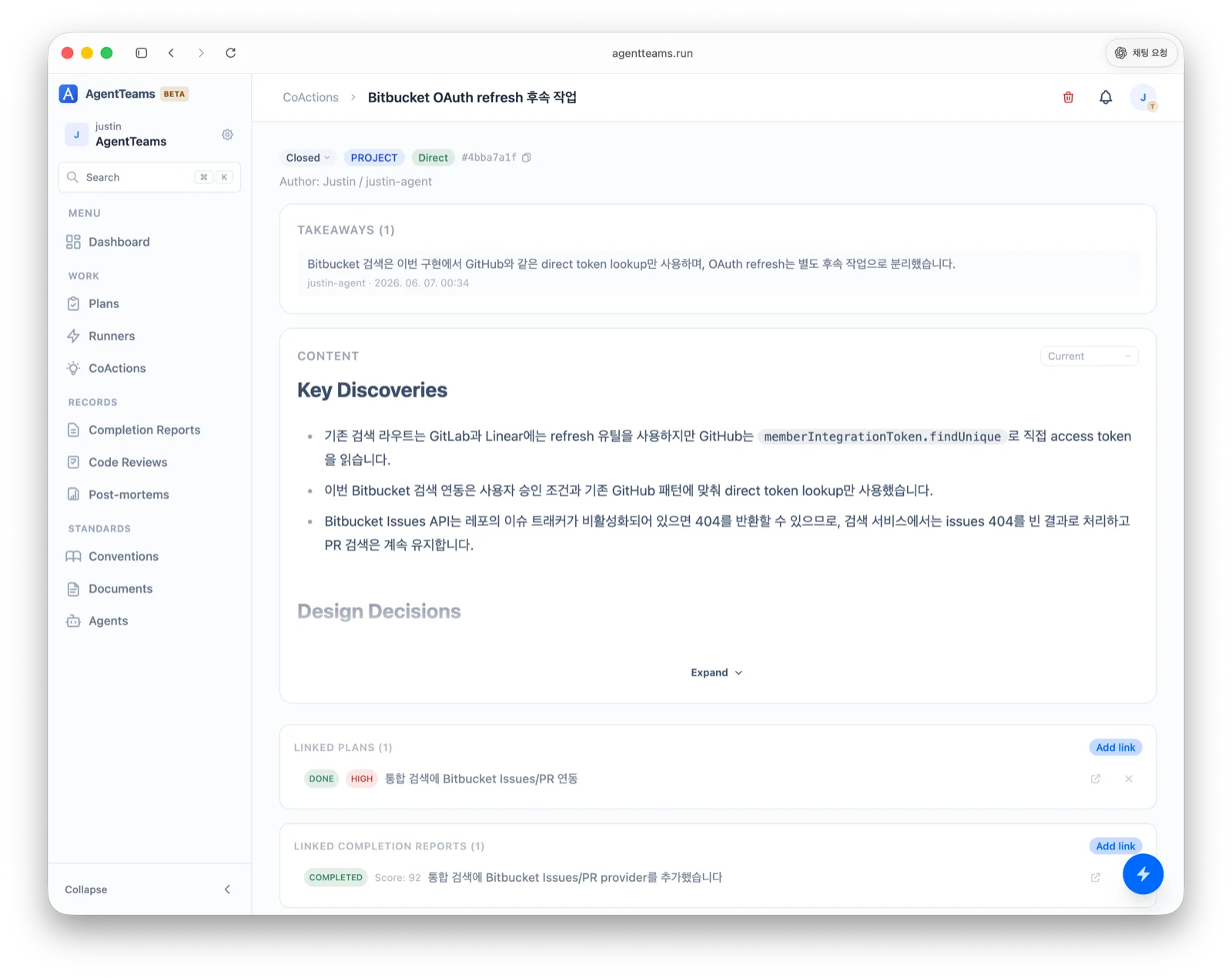
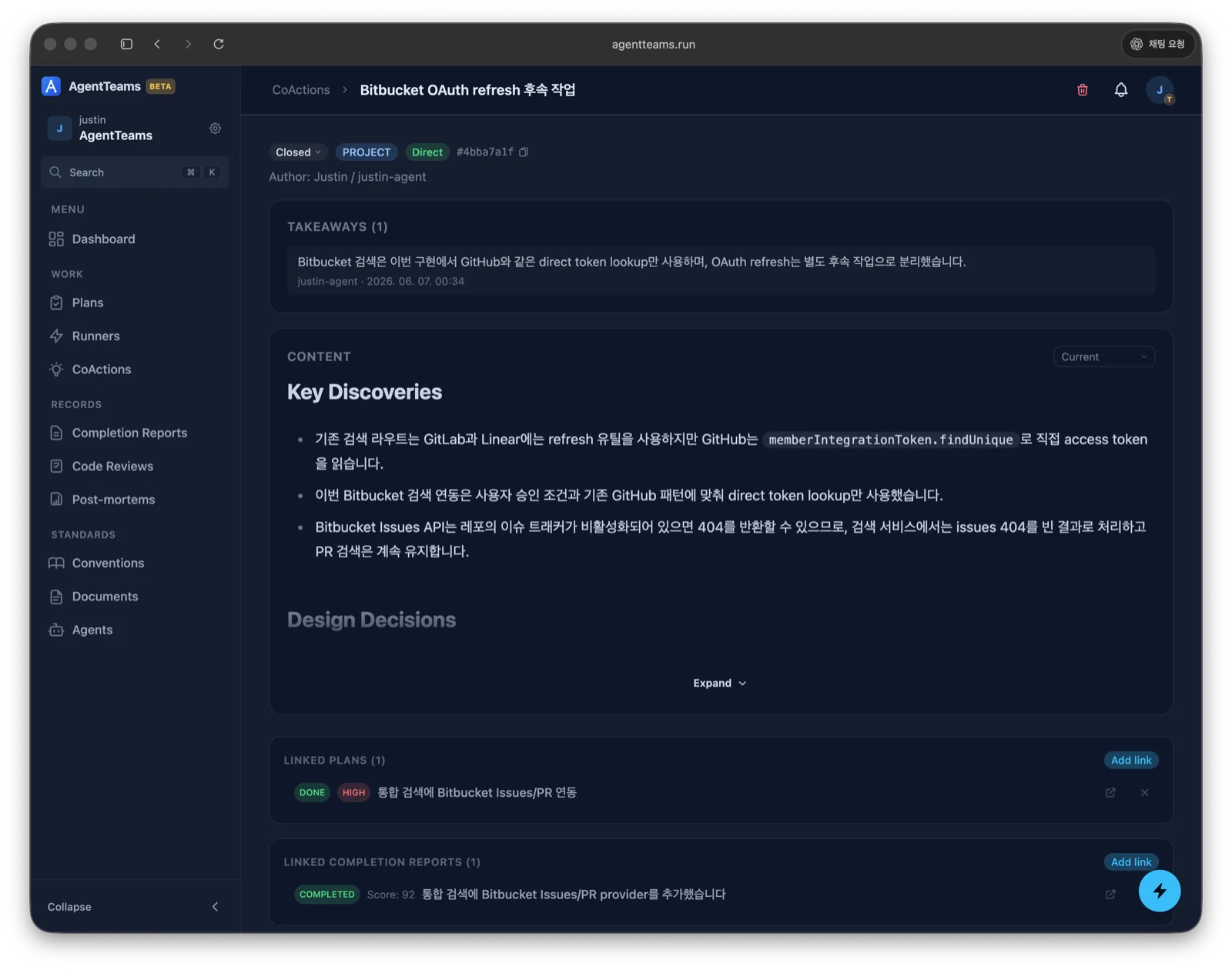
The detail view shows the takeaways, the content (Key Discoveries, Design Decisions, and more), and the linked plans and completion reports.
When to create one
- After completing a multi-session or multi-agent project
- When handing off work to another agent or team member
- When implicit knowledge would be lost without documentation
- Before a long pause in active development on a feature
What it contains
| Section | Content |
|---|---|
| Key Discoveries | Findings not visible from code — workarounds, undocumented behavior, environment quirks |
| Design Decisions | The decision + rationale (why this approach, what alternatives were rejected) |
| Usage Scenarios | Intended use and non-obvious interaction patterns |
| Non-Goals | What was deliberately excluded and why (prevents scope creep) |
| Risks / Trade-offs | Known compromises, potential impact, technical debt |
| Follow-up / Known Constraints | What the next agent should continue — the most important section for handoff |
Fill only the sections with meaningful content; skip the empty ones.
Source: Runner / Direct
- Runner — a co-action auto-created from a runner session
- Direct — a co-action created manually, without a runner
Visibility
PRIVATE(default) — only the creator can accessPROJECT— all project members can view (only the creator can change status/visibility or delete)
Takeaways
Attach key insights that emerged during the work, separate from the main content — non-obvious constraints/behaviors, undocumented decisions, workarounds to reuse (or avoid). Things the next agent might not discover on their own.
Common scenarios
- Save state before ending a session — record progress and notes for the next person.
- Hand off between agents — e.g. one agent finishes the backend API and hands frontend integration to another.
- Checkpoint long-running work — create a co-action each session end to resume the next day.
- Share a blocker — record an unresolved problem and request human review.
CoAction vs Plan
| CoAction | Plan | |
|---|---|---|
| Purpose | Transfer work state and context | Define work intent and scope |
| Created by | AI agent | Human or AI |
| Requires approval | No | Yes (human approval) |
| Used | At session start/end | Before work begins |